Tuesday, January 6, 2015

Making of Line Follower

What is Line Follower Robot?

It is a machine that follows a line, either a black line on white surface or vice-versa. For Beginners it is usually their first robot to play with. In this tutorial, we will teach you to make the line follower robot move on the line with a type of feedback mechanism.

Materials Required:


The main electronics/mechanical components that will be used in making this line follower robot are
·             1.Two sensors made using LDR,
·         2.Motor driver circuit
·         3.Acrylic sheet
·         4.General purpose board
·         5.Two DC motors
·         6.Battery. 

Lets start making it:


Step 1:


Chassis


It’s basically the frame of the robot on which motors and wheels are mounted and all the circuitry part is also placed on it.

For base, we will be using Acrylic sheet of square dimension and thickness of 4mm for our chassis, it can be easily available at any picture frame shop.

Acrylic sheet

Drive Mechanism

We will be using a three wheel differential drive using two motors and one caster wheel or an Omni directional wheel. The Direction and speed of the two motors can be controlled independently.  
Motor, Motor clamp and tyre

Caster wheel
chassis Layout
Our first step would be drilling holes to fix caster and clamps for motors. Though i haven't done any drilling while making this line following robot, just pasted caster and motor clamps with the help of double sided tape!!. But if you are making it for any small college project or competition fix every thing properly with screws. Also solder a 2 pin connector to the motors pins. 


Motors with connector
Now fix motors, caster and also attach wheels to the motors. As I said it is to made modular, attach a two pin connector to each motor.
Final chassis

Now the chassis is complete. Lets make its circuit!

Step 2:

Circuit

We will be using light sensors, particularly Light dependent Resistors (LDRs) to detect black line on white surface. The figure below will explain how to detect black line on white surface.

We will be using light sensors, particularly Light dependent Resistors (LDRs) to detect black line on white surface. Readymade Sensor module is available so that it will be very much accurate than building with our own components. To control the motor with output from the sensors microcontroller is needed. For beginners 8051 board will be useful or else u can also go with Arduino.
8051 MICROCONTROLLER
The 8051 basic microcontroller board which can be powered by a 9 volts – 12 volts battery (the battery volts varies the speed of the motor connected to the ports).The board placed must not be in contact with any insulator (chassis board). Also when placed directly with battery below the board short circuiting may happen causing the board to stop working. Hence always be cautious while working with the board
PORTS OF THE MICROCONTROLLER
There are four ports defined for the microcontroller. The ports are port 0, 1, 2, 3….for the board we use the ports connected are as follows
Port 0 and port 1: Sensor input.
Port 2: Motor.
Port 3: Switch
Knowing the sensor:
The sensor we normally use is a Light dependent Resistors (LDRs). It consists of an IR emitter and a LDR receiver .the receiver may give only the output as digital but the board may accept only analog input .Hence to convert to analog output we use a convertor .but the convertor may be inbuilt in some other boards. Array of sensor may be preferred since the distance between two sensors will be always fixed as 2 cm.

Knowing the header file:
The header file included in our program is <reg51.h>.this header file may consist the definition of the ports. Hence without including this file the ports usage may occur to be illegal. You are supposed to use the definition of ports only after including the file.
How to use the inputs:
The inputs from the sensor may be got and stored in variables and then comparison may be done. The variables for sensor may be defined using “”SBIT””. sbit is assigning a variable to a particular bit.in normal line follower or grid follower white and black are considered as 1’s and 0’s.


Hence the program will always begin as follows

#include<reg51.h>
Sbit s1=P1^0
Sbit s2=P1^1
Void main
{
……
……
……
…..
}
PROCEEDING FORWARD:
S1 and s2 used in the above program are just variables and may vary. The inputs from the pin 0 and 1 of port 1 get stored in the variables s1 and s2.
Consider that you have 2 sensor (line follower).the following principle may be used to follow the line
   ||
   ||
O || O
   ||
If both the sensor are white (input s1 1 s2 1) ==go forward
If right sensor becomes black (inputs s1 1 s2 0) ==go right
If left sensor becomes black (inputs s1 0 s2 1) ==go left
If both the sensor senses black (inputs s1 0 s2 0) == (input depends on your wish)
LEARN TO FEED THE MOTOR:
To connect a single motor you need to have two pin of a port (generally port 2).therefore you may connect 4 motors in a single port. Let us now learn to feed the motor port
To make a motor run forward the positive wire of the motor is given an input 1 and negative is given 0.
If the motor is connected to pins 0 and 1 of port 2, then the input to port 2 should be as follows
P2=0000 0010     
The hexadecimal equivalent of the above number will be 0X02.
The bot may be turned right if the right motor stops (or move reverse in acute cases) and the left motor moves as usual. The bot can be made to move left if the movement is vice versa.
The motor is feed as follows
P2=0x02.
P2 represents port 2.always in code “p” must be in capital letter.
A COMPLETE CODE USING 2 SENSOR:
#include<reg51.h>
Sbit s1=P0^0
Sbit s2=P0^1
Void main ()
{
While (1)
{
If ((s1==1) && (s2==1))
P2=0x0A;
If ((s1==0) && (s2==1))
P2=0x80;
If ((s1==1) && (s2==0))
P2=0x20;
Else
P2=0x80;
}
}                                                                                                                                                                                       
 The code contains an infinite while loop, this is to continue the process of taking the inputs. If the code do not contain the infinite loop, only once the code is executed.
The accuracy of the bot increases with increase in the number of sensor. If the code is done in the same way, with s1, s2, s3, s4, the time for execution increases and hence the accuracy decreases, the sensor input can be also taken in the form of hexadecimal values.

Now all the chassis and circuit part algorithm is done lets combine them all!

Step 3:

Combining all


Fix the sensor part just in front caster,facing downwards. ensure that there is very less clearance between sensor covering and ground. See the picture below.
Sensor Placement
Now connect the battery to the circuit and also plugin the motors in there respective connectors. For more information regarding battery and there charging circuit see this tutorial. I am using two 3.7V Li-ions cells in series for this robot.
Small cheap 9 V batteries will not be able to drive this robot for more that 4-5 minutes.

Complete Robot

Adjust the threshold of LDR such that when sensor is on black surface voltage at base of transistor must be less than 0.5Volts. If motors are rotating is reverse direction just change the polarity of that motor. After all this you would be able to make a robot that moves like the one below!.

Watch this video for better understanding. 

OR


Hope you liked this tutorial.


Saturday, January 3, 2015

A'MASS'

What is A'MASS'?


In Simple Words A'MASS' means to Assemble.

Very curious to know what it takes to clear the first round of AMASS?read ahead..

An open mind is definitely a pre-requisite for giving your best in the first round. If you've been observing things around you keenly you are most likely to clear it!

If you still are particular on preparing, well, brush up your ed skills!
General aptitude and pattern recognition.

Though words seem quite big, the questions are gonna be really easy yet tricky!


Free tip: if you've made paper boats when your small, would help you better in answering a question!

You could find the answer for this question when you come for the event, will fetch you extra credits over the others! :)


"What is the magnified value of an angle of 1.5 radians when viewed through a 10X magnifying glass?

HINT: magnification = dimension of image/dimension of object"


All the best! come and conquer the event :)

Friday, January 2, 2015

Hydraulic Arm

What is Hydraulic Arm?

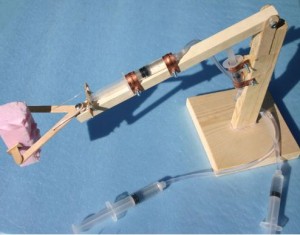
Hydraulic machines are machinery and tools that use liquid fluid power to do simple work. Heavy equipment is a common example.
In this type of machine, hydraulic fluid is transmitted throughout the machine to various hydraulic motors and hydraulic cylinders and which becomes pressurized according to the resistance present. The fluid is controlled directly or automatically by control valves and distributed through hoses and tubes.
The popularity of hydraulic machinery is due to the very large amount of power that can be transferred through small tubes and flexible hoses, and the high power density and wide array of actuators that can make use of this power.


Lets see how to make this.

Materials Used:

1.Card board/wood
2.Syringes-->7-8
3.Pipe(saline pipe)
4.Plastic Clamps
5.Small screws and nuts
6.Wire(binding wire)
7.Water (as working fluid)
8.Safety Scissors
9.Tape

**No electronic components are used**

How to make it?

Step 1:

1.Take the card board pieces and cut them as shown in the figure.
Make sure that your card board is strong to bare the weight of water filled syringe.

2.Insert the small piece of card board in that holes as shown.


This is the final setup required to bare a syringe.

Step 2:


Take a small piece of card board and drill four holes as shown.

We made that in order to fix the syringe tightly and prevent from falling.

Step 3:

Mounting

This structure depends on arena.You can make according to your use.
Take care when dealing with the binding wire.
Now arrange it as follows
This step is important and should do with care

Check the length of your syringe and cut the card board accordingly


This is the main part of mechanism

Step 4:

Arm Mechanism:

1.Cut the pieces in shape of arm as shown

2.The gripper is designed to move just one piece. It was more simple.
The "finger" was pasted fixed and mobile was seated on a shaft made with a piece of wooden stick that had a piece of cardboard cut in a circle glued on top so as not to leave the place.


Make holes in a proper way


Place a small wood stick in that hole to hold the arms.


Step 5:


Base Construction:


1.Cut the card board in the shape of hexagon for better movement as shown
2.Properly choose the place to make the holes according to your cardboard size.
3.Fit the base with screws and nuts as shown below.


The base was made from two pieces of cardboard in order to support arm and accommodate syringes in the same set.

The movable part has two holes:

- One in the center (to be able to rotate the base)

- The other end (to link the syringe and allow movement)

The syringe was attached to another piece of cardboard to keep the same level of mobile base.

After verifying the limits of movement, we fix the syringe with the clamps

Final look of base should be as follows:


Step 6:


Put all the parts together.

Here are some of the final pictures of the hydraulic arm.


Final Result:


Note:

This is the basic level of hydraulic arm.If you want to construct it with good quality of wood material
I would suggest you to click here

Also watch videos on youtube regarding hydraulic arm for better understanding.


Hope you liked this.

Come up with more innovative ideas:)
Thank you Guys
Have a great day:)

Making of Aqua Missile

What is Aqua Missile?

Question Arrises:

What is Missile?


An object which is forcibly propelled at the target,either by hand or from a mechanical weapon.

Aqua Missile:
In our case it is done with the help of water and a mechanical pump(launcher).

Launcher is used to pressurize the water inside the bottle to travel and hit the target.

How To Make It?

Here is the basic tutorial of making of a Aqua Missile(Water Rocket) with the help of household
articles.

**You need not buy any electronic components**

Materials Required:


1.Water Bottle(2 litre) ---2(preferably choose sprite or coke bottles for better performance)
2.Tape (to join two bottles).
3.Safety Scissors.(To cut the bottle)
4.Card Board(or old cd's)

Step 1:


Take Two 2 litre bottles


Step 2:


Cut one of the bottles into three parts. Please keep the bottles top and middle section as shown.


Step 3:


Stick the bottles top into the other bottle’s bottom part.


Step 4:


Stick the first bottle’s middle section into the second bottle’s top part.(Please use the insulating tape.)


Step 5:


Cut four acrylic boards as the four empenages of the rocket.


Step 6:


Fill 1/3rd of bottle with water.


Step 7:


Make sure the atmospheric pressure inside the bottle is 70-75% for best results.


That's it your Missile is ready to clear the space...\
This is just a basic working model targeted at beginners.Please come up with more innovative models.IMPROVISATIONS ARE APPRECIATED. :)

Note:Make sure Launching angle is 45 degrees for maximum range.
**Priority will be given for Eco-friendly model**

Hope you liked this...
Thank you,have a great day.

Making of Ornithopter

 What is an "Ornithopter"?


 An ornithopter is a device that imitates the flapping-wing flight found in nature. The word "ornithopter" (c.1908) combines the ancient Greek words for "bird" and "wing". An ornithopter doesn't need to have feathers, though. What makes it birdlike is the flapping motion! Airplanes have a rotating propeller. Helicopters have a rotary wing that provides both lift and thrust. But animals don't have any rotating parts!

How to Make It?

What are the materials required?


1.Balsa Wood/Ice cream Sticks.
2.Music Wire(Binding Wire)
3.Glue/fevikwik/fevicol(Adhesives)
4.Small Beads
5.Tissue Paper
6.Medium Thick Rubber Band
7.Small Quantity of vegetable oil to smoothen the rubber(optional)
8.Scissor(to cut sticks)
9.1 hour of your time
Thats it....No electronic components are used.....!!!!

Procedure:

Step 1:


Making of Fugelage:


Question Arrises....

What is Fuselage?


 Fuselage is an aircraft's main body section that holds crew and passengers or cargo.


Make a hook in the rear tail motor attachment wire. Push the wire carefully through the center of motor stick at a point three-fourth inch from tail end.


Next, make two 90 degree bends in wire and glue into place using Adhesive.  Reinforce the wire-to-balsa/Sticks joint by putting a tissue paper cover over it.  Dab the joint w/thin layer of Adhesive

Make Paper Rolls:


 Cut into three 1/2" long tubes.  Attach the tubes to the fuselage as shown using the Adhesives


Step 2:


Use  pliers to bend the wire for the crank.  Insert the crank wire through the paper tube glued to the crank standoff.  Make a 60 degree bend in the center of the 3/4" side.  Place 3 beads on the wire (as shown).  Make a bend in the back part of the wire for a motor hook

Finally It should look like this

.

Step 3:


Making of Wing Spars


Question Arrises:

What are Wing Spars?

  1. In a fixed-wing aircraft, the spar is often the main structural member of the wing, running spanwise at right angles (or thereabouts depending on wing sweep) to the fuselage. The spar carries flight loads and the weight of the wings while on the ground.

Bend music wire as shown.  Carefully push wire through wing spar at a point 3/4" from one end.  Glue into place using Adhesive and reinforce the joint by wrapping layer of tissue paper around the joint and coating with Adhesive. Repeat process for 2nd wing spar
Finally it should look like this:


Step 4:


Making of Tail


Use Adhesive to glue the balsa rods into a T shape.  Reinforce the joint by covering it with tissue paper soaked w/thin layer of Adhesive.  Poke the end of the fuselage tail attachment wire into the balsa tail member.  Then glue the assembly and finally reinforce by wrapping.


Step 5:


Make the Connecting Rods


Harden the rods by coating the last 1/2" of each end of both with CA.  Make 2 holes for the music wire in each in each connecting rod, 1/4" from each end


Step 6:


Making of Wings


Cut out tissue paper wings as shown.

Step 7:


Assemble the parts


Glue tissue paper wing to wing spars and the top wing attachment member.  Next, glue tissue paper tail to the balsa T frame w/glue stick.  Connect connecting rods to the wing spar attachment wires and crank.  Adjust spacing of connecting rods so the crank turns smoothly.  

Place heat shrinkable tubing over the crank and wing spar wires to maintain alignment, and carefully heat w/match to shrink tubing. NOTE: Materials are very flammable, so use great care!  Finally, bend the tail up so that it is at about 15 degrees from the plane of the motor stick


Step 8:

Place rubber band over the front and rear motor attachment hooks.  Wind up the rubber band motor by turning the crank 30-35 times.  Angle the ornithopter's nose up slightly and release gently. *Optional: Rub the rubber band with a little vegetable oil for lubrication; this can help it go smoother


Thats it ..Hope you understood the procedure of making an ORNITHOPTER.
Just spend an hour and try it.

Note:Make your model according to the dimensions given.

For More understanding I will place a video tutorial youtube link for you.
click here